
Are you looking for effective ways to enhance and prolong the benefits of your acupuncture or massage treatment sessions?
Therapeutic taping may be the right ‘do-it-yourself’ strategy!
In this blog, we examine the origins of taping, the mechanisms by which it is theorized to work, and the subtle differences between kinesiology taping and acupressure taping. We also review common uses, contraindications, and general principles for therapeutic taping.
Introduction
Therapeutic taping is relatively simple, but the principles behind it pull from sports medicine, rehab, acupuncture, and modern pain science. Taping gives the body subtle, continuous input that can support movement while healing.
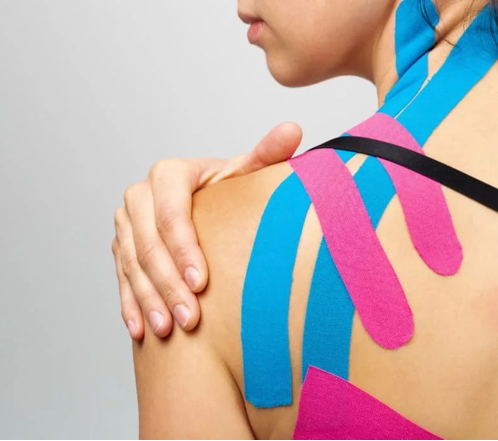
Kinesiology taping (often shortened to ‘kinesio taping’ or ‘KT taping’) is that brightly colored, stretchy athletic tape you’ve likely seen on shoulders, knees, backs, and ankles. This is especially prevalent during the Olympic Games.
Acupressure taping (acu taping) integrates the principles of Traditional Chinese Medicine and addresses the meridians. Pink tape is used for a warming effect to move Qi and blood. Blue tape has a more cooling effect, perfect for slightly inflamed or ‘hot’ injuries. Tan tape is considered neutral and is used when neither heating nor cooling properties are indicated.
Therapeutic Tape Evolution
Traditional athletic taping was a form of rigid strapping. It was designed to restrict motion, like a cast or a brace. Stiff tape was applied to limit range, protect a joint, and prevent re-injury. In the 1970s, Japanese chiropractor Dr. Kenzo Kase sought a different approach for people who needed support, but also needed to keep moving normally. He developed an elastic cotton tape designed to mimic the stretch and recoil of skin. His premise was that controlled movement itself is therapeutic. If you can reduce pain and improve mechanics without immobilizing the area, you may be able to stay active while tissues recover. Courses in his Kinesio Taping Method expanded through Japan and later internationally, with major visibility after elite athletes wore it publicly in the 2000s.
Therapeutic Tape Mechanisms
Therapeutic tape is not a ‘healing chemical’ and it doesn’t fuse torn tissue back together. Its potential benefits are more about gentle mechanical effects and nervous-system input.
1. Sensory input and pain modulation
Tape stimulates the skin’s mechanoreceptors – touch and pressure sensors that relay information to the spinal cord and brain. For some people, that steady sensory signal can reduce pain sensitivity (‘turn down the volume’ effect), improve body awareness (proprioception), and help movement feel safer and smoother. This is one reason many people report quick changes in comfort and stability, even when underlying tissue healing is still ongoing.
2. Movement guidance and motor control
Depending on how it’s applied, tape can act like a reminder: “keep the shoulder blade here,” “don’t collapse into the arch,” or “track the kneecap more comfortably”. Think of it as a light cue; it may help you rebuild stable patterns more consistently during activity.
3. Swelling management (lymphatic effect)
The elastic tape itself provides a gentle, consistent massage to the injured area. Because the skin adheres to the tape, it is shifted against the sub tissue during motion, causing lymph tissue to drain and connective tissue to be massaged. Some taping styles use fan-shaped strips with minimal stretch to create subtle lifting of the skin. The theory is that this may improve microcirculation and lymphatic drainage by reducing pressure in the superficial tissues. Evidence is mixed, but many clinicians find it can be a useful adjunct for mild swelling and bruising when combined with movement and other basics.
4. Confidence and stability
A practical and underrated mechanism is behavioral. When pain makes you guard, the tape can be a reassuring external support that helps you move more normally. This feedback often improves function, even if the tape itself is not ‘fixing’ the injury.
Research overall suggests kinesiology tape may offer small-to-moderate short-term improvements in pain and function for some conditions, especially when used alongside exercise, load management, good rehab and ergonomic habits, and various therapies and interventions. It’s usually not a stand-alone cure and responses vary a lot person to person.

Kinesiology Taping
Kinesiology taping is most often used to support activity while calming irritation. Common scenarios include:
- Overuse aches where you still want to train or work (tendon irritation, mild joint pain)
- Post-acute strains/sprains after the first ‘angry’ phase has settled
- Mild swelling or bruising that lingers
- Posture or movement retraining (as a cue during exercise)
- Returning to sport or lifting when you’re not ready for full intensity but want guidance
For many people, the best use is temporary – a useful tool while you rebuild strength, mobility, and tolerance.

Acupressure Taping
Acupressure taping (acu taping) combines kinesiology taping with Traditional Chinese Medicine. It is used for musculoskeletal conditions like those referred to for kinesiotaping. However, it is also used for more systemic issues such as headaches, digestive disturbances, even morning sickness! Stomach pain and menstrual pain can also be addressed with acutaping. Unlike kinesio taping, acu taping is applied to specific meridian points to alleviate pain, reduce inflammation, and improve circulation. Tape is placed along key meridian pathways that may be near or far from the local site of the condition. Morning sickness is treated by taping along the inner portion of the forearm, passing through a number of acupressure points that treat nausea. Headaches are treated by taping muscles and meridians in the upper back and neck. Taping is also applied to the sacrum at the bottom of the spine, recognizing the role overall axial/spinal tension plays in tension headaches, for example.
Contraindications and Cautions
Therapeutic taping is generally safe, but avoid or get professional guidance if any of the following apply:
- Skin allergy or sensitivity to adhesives (itching, blistering, rash): stop immediately if this occurs
- Open wounds, fragile skin, active skin infection, or uncontrolled eczema/dermatitis
- Known or suspected blood clot (DVT), unexplained calf swelling/redness/warmth, or sudden shortness of breath: SEEK URGENT EVALUATION
- Significant circulatory problems or severe diabetes-related skin vulnerability (higher risk of skin breakdown)
- Cancer-related swelling/lymphedema: only tape under clinician guidance
- Pregnancy: avoid taping patterns that increase abdominal compression and seek clinician guidance for low back/pelvic support
- If taping increases numbness/tingling, color changes to the skin, or worsening pain, then remove it immediately
Therapeutic Taping Strategies
Kinesio and acu tapes are elastic cotton fiber tapes with no latex. The tape has an acrylic glue that expands when heated and contracts when it is cooled. It takes about a 1/2 hour for the glue to fully activate once on the skin, at which time the tape will be stickier and adhere more tightly to the skin. The glue is arranged in waves so that the skin can actually breathe and perspire through the tape. You can shower with the tape, as water does pass through it.
With acu taping in particular, you want to stretch the area you intend to tape before applying the tape. For example, to apply tape to the back, ask the person to bend forward and round their back. Measure the amount of tape you will use to cover the desired area with the person in this stretched position. The tape adheres better if you first round the edges of the extremities of the strip. Apply the tape, anchoring one end and gradually work your way down to attach the free end.
Tape for a period of five to ten days for best results. You may want to change the tape every 2-3 days. If there is no improvement after this period, or if your condition worsens, consult with your physician.
Conclusion
Use therapeutic tape to ‘buy you comfort’ and keep you moving while you heal. More importantly, be sure you are sensible in your activities and occupation. Lift properly. Pace yourself. Take frequent rests. Vary your activities whether you are sedentary or active. Engage in gradual strengthening, stretching, and mobility exercises. Be sure to prioritize proper rest, hydration, and nutrition.
* If pain is severe, persistent, or associated with significant swelling, instability, fever, unexplained weakness, or numbness, get assessed by a medical professional. Tape shouldn’t be used to push through red flags!
Therapeutic taping is best when it’s modest in promise and smart in timing. It is a supportive nudge, not a miracle; often helpful, sometimes neutral, and rarely harmful, when used appropriately.
This blog is not meant to replace medical attention. If you are injured, then you should first consult with your physician. Confirm that therapeutic taping is not contraindicated and your doctor has ruled out that your pain or discomfort is not masking a more serious medical condition. Then consult with a clinician – be it an acupuncturist, chiropractor, massage therapist, occupational therapist, osteopath, or physical therapist – on suggestions, strategies, and patterns for therapeutic taping. There are also many DIY sources and guides on how to use kinesio or acu taping effectively.
Sources
Acupressure Taping: The Practice of Acutaping for Chronic Pain and Injuries Hans-Ulrich Hecker April 2007 Healing Arts Press Rochester, VT
https://www.innertraditions.com/books/acupressure-taping
https://pubmed.ncbi.nlm.nih.gov/34442453/ (Kinesiotaping vs. auricular acupressure for menstrual pain)
https://osteopath.blog/en/methods/kinesio-taping-techniques.html
https://www.google.com/search/acupressure+taping