
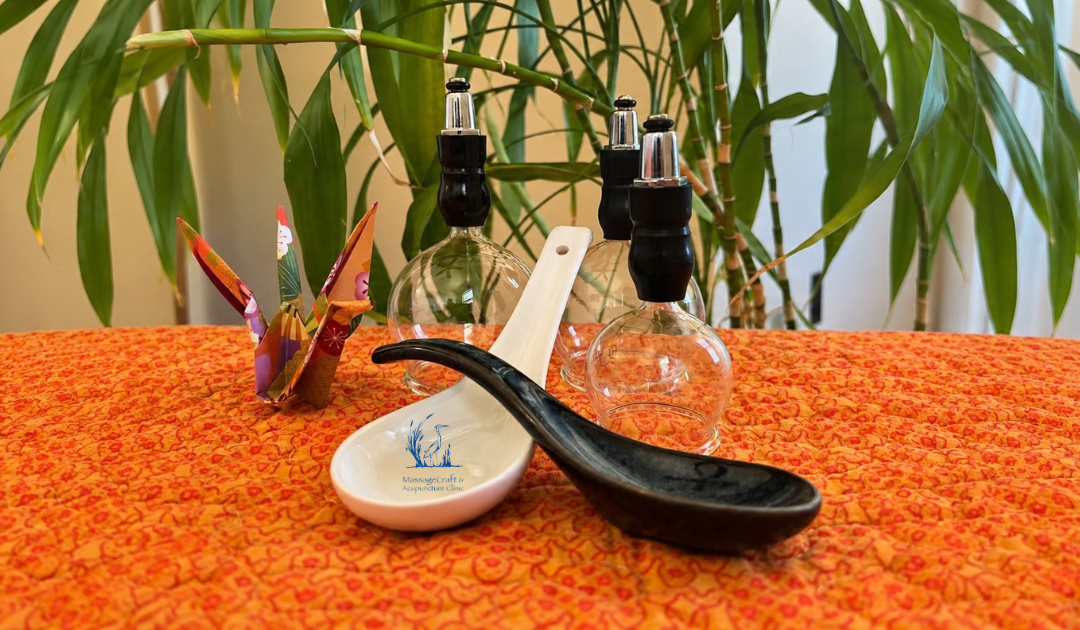
Have you ever noticed the circular or streak-like marks on the skin of professional athletes or Olympians and wondered the cause? These temporary marks are often the result of cupping or Gua Sha – two complementary techniques that are often incorporated into acupuncture or massage treatments. Here’s what you need to know and the role they can play in your treatment plan.
Acupuncture is one of the four branches of Traditional Chinese Medicine (TCM), and a treatment rarely consists of needling alone. (For a deeper look into specific approaches and techniques, we invite you to re-read two previous blog posts: It’s Your First Acupuncture Appointment: What Can You Expect? (Aug 2025) and Acupuncture Without Needles? (Sep 2025).) Cupping and Gua Sha stimulate the skin, fascia, and muscles, as well as the meridians that run through tissues. In combination with needles, this more comprehensive approach can support treatment of a variety of concerns, whether musculoskeletal, emotional, or internal.
Our massage therapists may also choose to incorporate cupping and/or Gua Sha into a treatment. While these techniques may have benefits that extend to the internal organs, meridians, and emotional wellbeing with acupuncture, the primary focuses in massage therapy are the muscles and fascia. These techniques can be particularly useful when the goal is to address acute and/or chronic musculoskeletal tension and pain.
In this blog, we’ll define and compare cupping and Gua Sha techniques so you understand the unique role each may play in your treatment plan. Our practitioners may also recommend using these methods between treatments as part of your self-care routine. We’ll briefly discuss important precautions for personal use and provide supplemental educational resources.
The Core Difference: Suction vs. Scraping
Cupping and Gua Sha techniques are often grouped together and practitioners may use both during the same treatment. Both are Traditional Chinese Medicine (TCM) techniques that can leave visible marks on the skin. Cupping also has roots in many Eastern European folk traditions. In Poland, Russia, and Greece, glass jars, such as jelly jars, were used for fire cupping. In Cambodia, a form of Gua Sha called Coining is practiced. It involves skin scraping with a smooth-edged object, traditionally a coin.
Although cupping and Gua Sha are sometimes used for similar purposes, they rely on very different forms of mechanical stimulation. They may be used to address different Traditional Chinese Medicine (TCM) patterns and have distinct safety considerations, particularly when used at home. If you’ve ever wondered why cupping leaves circular marks while Gua Sha produces streaky areas of redness, and whether those marks are actually bruises, here’s a clear, clinically grounded look at the differences.
Cupping: Creating Suction
Cupping uses negative pressure, or suction, to gently lift the skin and superficial tissues. In TCM, cupping is traditionally understood to help “open” the exterior and influence the movement of qi and blood. Cupping may also be used to release stagnation and constraint. Some TCM practitioners understand the protective layer of qi at skin level and just beneath, known as Wei Qi, as being closely related to the body’s defensive or immune function.
From a Western biomedical perspective, the skin plays an important role in protecting the body and supporting immune function. The effects of cupping, however, are more specifically associated with the local tissues being treated.
Cups may be left stationary over an area in static cupping. A lubricant can also be applied so that the cups can be moved across the skin in sliding or moving cupping.
In biomedical terms, suction draws blood toward the surface of the skin. This action may increase local circulation and alter the mechanical properties of superficial tissues. With sliding cupping, the movement of the cup may also influence superficial fascia and fascial glide. For some people, cupping may help decrease protective muscle guarding and alter the way pain is perceived.
Gua Sha: Pressing and Scraping
Gua Sha uses a smooth-edged tool to apply pressure and repeated, unidirectional strokes over lubricated skin. Unlike cupping, which lifts the tissues through suction, Gua Sha primarily applies compression, stroking, and shearing forces to the superficial tissues.
In TCM, Gua Sha is traditionally used to “release the exterior”, particularly in patterns associated with the early stages of wind-cold or wind-heat. Like cupping, it may be used when a practitioner is working to prevent an illness, such as a cold, from progressing, or to address lingering symptoms of congestion or cough. Gua Sha is also traditionally used to move qi and blood when stagnation in the channels is associated with stiffness, discomfort, or pain.
From a biomedical perspective, Gua Sha produces a temporary increase in local microcirculation and provides strong sensory input to the nervous system. The pressure and movement of the tool may also affect superficial fascia and fascial glide can influence how the nervous system processes pain.
To summarize the two techniques, cupping lifts and separates, while Gua Sha presses, strokes, and scrapes. Both techniques can influence circulation, superficial tissues, and pain perception, but they do so through different mechanical actions.
TCM Patterns Responsive to Cupping
While TCM diagnosis should always be individualized, certain patterns are commonly considered responsive to cupping. Based on your specific presentation, our practitioner will determine whether cupping is appropriate.
- Qi and blood stagnation: Often associated with fixed or localized pain, tightness, muscular knots, or lingering soreness.
- Cold-damp obstruction: May present as a feeling of heaviness, achiness, or sluggishness that is aggravated by cold or damp weather.
- Wind-cold invasion: May involve a tight upper back or neck accompanied by chills. As mentioned above, sliding cupping over lubricated skin may be used in some cases to help address the early stages of a cold.
- Phlegm congestion affecting the Lung: In appropriate cases, cupping over the upper thoracic region may be used when phlegm congestion presents as a lingering cough or contributes to respiratory symptoms such as asthma.
TCM Patterns Responsive to Gua Sha
Gua Sha is also used for a variety of TCM patterns. As with cupping, treatment should be based on a full, individualized assessment, rather than a symptom alone.
- Exterior patterns: Gua Sha may be used in the early stages of a cold or flu-like illness, particularly when symptoms include a stiff neck, body aches, fever, or chills. The specific approach may vary depending on whether the presentation is characterized as wind-cold or wind-heat.
- Channel stagnation: Gua Sha may be particularly useful when stagnation is associated with stiffness, pain, or restricted range of motion. Common areas include the neck and shoulders, jaw, forearm, and iliotibial (IT) band region.
- Occupational or sports-related muscle tension: When repetitive activity, athletic training, or physical work creates persistent muscle stiffness and restricted mobility, a more vigorous approach may be appropriate. Gua Sha can provide a form of mechanical stimulation beyond what needling alone can offer.
Petechiae vs. Bruising: Those Marks Explained
The post-treatment marks from cupping and Gua Sha can look alarming, especially if you’re seeing them for the first time. Although they may resemble bruises, the discoloration is produced by a different mechanism than a typical, traumatic bruise.
- Petechiae are tiny, pinpoint areas of discoloration caused by small amounts of blood escaping from superficial capillaries into the surrounding tissue.
- Ecchymosis is a larger area of discoloration caused by a similar type of blood leakage beneath the skin.
- A traditional bruise or contusion, generally results from blunt trauma that damages blood vessels and underlying tissues more directly.
With cupping, the negative pressure can produce circular areas of petechiae or ecchymosis, which correspond to the shape and intensity of the cup. With Gua Sha, repeated strokes across the skin can create streaky or linear areas of redness and discoloration. In TCM, these markings are referred to as “sha” and are traditionally understood as reflecting the movement of qi and blood through areas of stagnation.
There is an important distinction, however. Although these marks are not necessarily bruises in the conventional sense of a traumatic injury, they do represent blood beneath the skin. From a TCM perspective, the appearance of sha is associated with the release of qi and blood stagnation in the treated area.

Credit: ACA Acupuncture & Wellness

Credit: Live Oak Acupuncture
The purpose of cupping and Gua Sha is not creating a mark. Rather, the marking is a visible consequence of the mechanical stimulation applied to the tissues. When these techniques are selected and performed appropriately, with consideration for an individual’s constitution, medications, medical conditions, and skin sensitivity, these techniques may help improve local circulation, tissue mobility, and the body’s ability to resolve areas of restriction.
Over a course of treatment, improved tissue mobility and circulation may contribute to decreased pain and improved range of motion. For some, these changes can be quite dramatic.
Dosage: How Much Is Enough?
Like many therapeutic techniques, cupping and Gua Sha have a dose. The goal is not to create the darkest marks or tolerate the most discomfort. A well-dosed treatment should provide an appropriate amount of stimulation for your body and your treatment goals.
A healthy response may include:
- A feeling of warmth in the treated area as circulation increases
- Reduced muscular tightness
- Easier or more comfortable movement
- Mild sensitivity, if any, rather than significant tenderness
- Marks that gradually fade over an average of 2–7 days
More Is Not Necessarily Better
If the technique is too intense, you may experience sharp or excessive discomfort. Your practitioner should check in with you regularly and adjust the pressure and application according to your tolerance and response.
Those who are experienced with cupping or Gua Sha may choose a stronger treatment because they have learned how their bodies respond. For those new to these techniques, however, this is not a “no pain, no gain” proposition. Your practitioner may intentionally back off before you feel the need to cry, “Uncle!”
In fact, the intensity of the marks is not a measure of therapeutic benefit. Even a very light response can indicate that the tissues have received meaningful stimulation. The goal is an appropriate response, not the most dramatic one.
When the Treatment May Have Been Too Vigorous
Significant blistering, swelling, persistent soreness, or very dark marks that do not begin to resolve within 48 hours may indicate that the treatment was more vigorous than appropriate for your body. If you experience any of these responses, let your practitioner know. This information can help them adjust the intensity, duration, or technique of subsequent treatments.
It’s also important to inform your practitioner if you experience dizziness or unusual fatigue after treatment. Some people feel a brief period of tiredness followed by a sense of relaxation or renewed energy after resting. Fatigue that feels prolonged, draining, or otherwise concerning is different and should be communicated to your practitioner.
Ultimately, the right “dose” is the amount of stimulation your body can comfortably respond to while moving you toward your treatment goals.
Benefits of These Techniques
Cupping and Gua Sha can be useful tools for addressing muscle tension, pain, and restricted movement. The benefits vary from person to person and depend on the technique, intensity, and underlying condition being treated.
Commonly Reported Benefits of Cupping
- Rapid reduction in muscle guarding and persistent tightness, particularly when tissues feel “stuck” or resistant to movement
- Relief of localized muscular pain, including common areas such as the upper trapezius, low back, and gluteal muscles
- A greater sense of openness through the chest and back, with some people reporting that breathing feels easier after treatment
- Support for recovery after overuse, particularly when cupping is applied gently and at an appropriate time following strenuous activity
Commonly Reported Benefits of Gua Sha
- Improved range of motion and reduced stiffness, especially in areas of muscular restriction
- Relief of tension-related headaches associated with tightness in the neck and shoulders
- Reduced jaw and facial tension when gua sha is performed gently and on appropriate tissues
- Support during the early stages of a cold, reflecting its traditional use for exterior patterns, particularly when accompanied by neck and upper-back tightness
Part of a Bigger Picture
Cupping and Gua Sha are not cure-alls, nor are they intended to replace appropriate medical care. They are most effective as part of a broader treatment and healthcare plan that may include adequate hydration, rest, movement, stress regulation, acupuncture, massage, or other forms of manual therapy.
The goal is not simply to create a temporary sensation of relief, but to help you move more comfortably and to support your body’s ability to recover and function well.
Contraindications and Precautions for Cupping and Gua Sha
Cupping and Gua Sha can be appropriate for many people, but they are not suitable in every situation. Always inform your practitioner about your medical history, medications, recent procedures, and any health changes before treatment.
If any of the following apply to you, do not attempt cupping or Gua Sha at home without first consulting an appropriately trained healthcare professional:
- Bleeding disorders, easy bruising, or blood-thinning medications, including certain anticoagulants and antiplatelet medications
- Pregnancy, particularly abdominal or lumbosacral treatment, unless performed by someone appropriately trained in prenatal care
- Broken or irritated skin, including open wounds, rashes, active eczema or psoriasis flares, or sunburn
- Fever, significant infection, or systemic illness – vigorous stimulation may not be appropriate
- Varicose veins – avoid direct treatment over affected veins
- History of deep vein thrombosis (DVT) or unexplained swelling – requires appropriate medical evaluation and clearance before treatment
- Areas affected by cancer treatment, increased risk of lymphedema, or recent surgery – these situations require individualized guidance as wells appropriate medical evaluation and clearance before treatment
- Fragile skin, including skin affected by advanced age, long-term corticosteroid use, or connective-tissue fragility
Cupping-Specific Precautions
Cupping requires particular attention to the location, amount of suction, and length of time the cups remain in place.
- Avoid placing cups directly over major blood vessels, very thin skin, or prominent bony areas.
- Avoid leaving stationary cups in place for excessive periods. Prolonged or excessive suction can cause significant skin irritation or blistering.
- Use particular caution with people who are prone to fainting or vasovagal reactions. The combination of suction, sensory stimulation, and nervous system responses can be more than some people tolerate comfortably.
- Adjust suction intensity to the individual. Stronger suction is not necessarily more therapeutic.
Gua Sha-Specific Precautions
Gua Sha involves direct pressure and repeated strokes across the skin, so the amount of pressure and the location of treatment matter.
- Avoid aggressive scraping over the front or sides of the neck, underarms, groin, and other areas where lymph nodes or sensitive structures are prominent, unless you have been properly trained to work in these regions.
- Use particular care or avoid delicate, irritated, or fragile skin.
- Do not chase “more sha”. A darker, more extensive mark is not necessarily a sign of a better treatment. The goal is an appropriate therapeutic response, not the most dramatic discoloration.
- Stop if you experience sharp pain, unusual swelling, dizziness, or other concerning symptoms during treatment.
When in doubt, consult your practitioner before treating yourself. Proper assessment, technique, and dosing are especially important when medications, medical conditions, pregnancy, recent surgery, or fragile skin are involved.
Home Use: How to Keep Cupping and Gua Sha Safe and Effective
If you’re practicing either technique at home, remember the basic rule: gentle, brief, and strategic. Home treatment should be about providing appropriate stimulation – not trying to reproduce the intensity of a professional session.
Home Cupping Basics
- Use light suction and keep the cups in place for a short period – often 30 seconds to a few minutes per area.
- Consider moving or sliding cupping with oil rather than leaving a cup stationary in one location.
- Stop immediately if you experience sharp pain, numbness, tingling, burning, or any sensation that feels wrong.
- Never cup over acne, broken skin, cuts, rashes, sunburn, or other areas of irritation.
- Clean your cups thoroughly with warm, soapy water and rinse well after each use. Allow them to air dry completely before storing them.
Home Gua Sha Basics
- Use a smooth-edged tool and plenty of lubricant to allow the tool to glide easily across the skin.
- A simple porcelain soup spoon can be an excellent Gua Sha tool. Metal spoons tend to have thinner, sharper edges and are more likely to irritate the skin.
- For lubrication, vegetable oil provides reliable, sustained glide. Many moisturizing products contain alcohol or other ingredients that can evaporate quickly, making them less effective for prolonged Gua Sha.
- Use moderate pressure. You should feel warmth and perhaps mild, tolerable discomfort – not sharp or burning pain.
- Keep your strokes slow and primarily in one direction, and limit the number of passes. With Gua Sha, quality is more important than quantity.
- For facial Gua Sha, use an especially light touch. Facial skin is delicate, and bruising or pronounced discoloration is a sign that too much pressure has been used.
Aftercare for Cupping and Gua Sha
Following either technique, give your body some time to integrate, respond, and rebound.
- Hydrate well.
- If you are prone to dizziness, avoid very hot showers, baths, or saunas immediately after treatment.
- Mild soreness or tenderness can occur. If you have significant marks or soreness, refrain from intense exercise involving the treated areas for the rest of the day.
- Arnica gel or calendula cream may be used to help reduce the appearance of marks.
- If you feel particularly sore or depleted after treatment, an Epsom salt bath may be relaxing and soothing.
- Keep the treated areas comfortably warm. Use gentle warmth rather than ice, unless there is another medical reason to use cold therapy.
Most importantly, listen to your body. Personal cupping and Gua Sha should leave you feeling relaxed, mobile, and appropriately stimulated – not beaten and bruised. If a technique consistently leaves you feeling worse, then the intensity, duration, or application should be reconsidered.

Credit: The House of Rose
The Takeaways
Cupping and Gua Sha can both be used to address stagnation and influence local circulation, but they do so through different forms of mechanical stimulation.
- Cupping lifts and decompresses the superficial tissues through suction.
- Gua Sha presses, strokes, and mobilizes the tissues through controlled scraping.
The marks produced by these techniques are generally petechiae or ecchymosis rather than a classic, traumatic bruise. They are a visible response to the treatment, but darker or more extensive marks do not necessarily mean greater therapeutic benefit. The intensity of treatment should always be carefully matched to the individual.
With appropriate screening, thoughtful technique, and conservative personal use, cupping and Gua Sha can be valuable tools within a broader treatment plan. They are most useful when guided by an individualized TCM pattern assessment and a clear therapeutic goal, whether that goal is pain relief, improved mobility, reduction of muscular tension, or support during early stages of an exterior pattern.
As with any therapeutic technique, the goal is not to do more, but to do what is appropriate for your body, your condition, and your treatment goals.
For those interested, Lisa Bouchard, LMT, LAc, will be teaching two classes on personal Gua Sha use this fall through OOB/Saco Adult Education. Gua Sha spoons included. Please see below graphic for registration information.

This blog is not intended to replace consultation with a medical professional. Please seek attention from a clinician for any of the conditions mentioned above. If symptoms are severe, persistent, or include breathing difficulties, then seek medical intervention as soon as possible. Acupuncture and massage may be important supports for allopathic intervention.
Sources
Manaka, Yoshio, Kazuko Itaya, and Stephen Birch. Chasing the Dragon’s Tail: The Theory and Practice of Acupuncture in the Work of Yoshio Manaka. Paradigm Publications, 1995. ISBN 978-0-912111-32-2.
https://my.clevelandclinic.org/health/treatments/16554-cupping
https://www.thehouseofrose.com/cupping-gua-sha-fascia
https://health.clevelandclinic.org/why-gua-sha-might-be-good-for-you
https://acaacupuncture.com/blog/what-is-gua-sha-how-it-works-and-how-it-complements-acupuncture/