
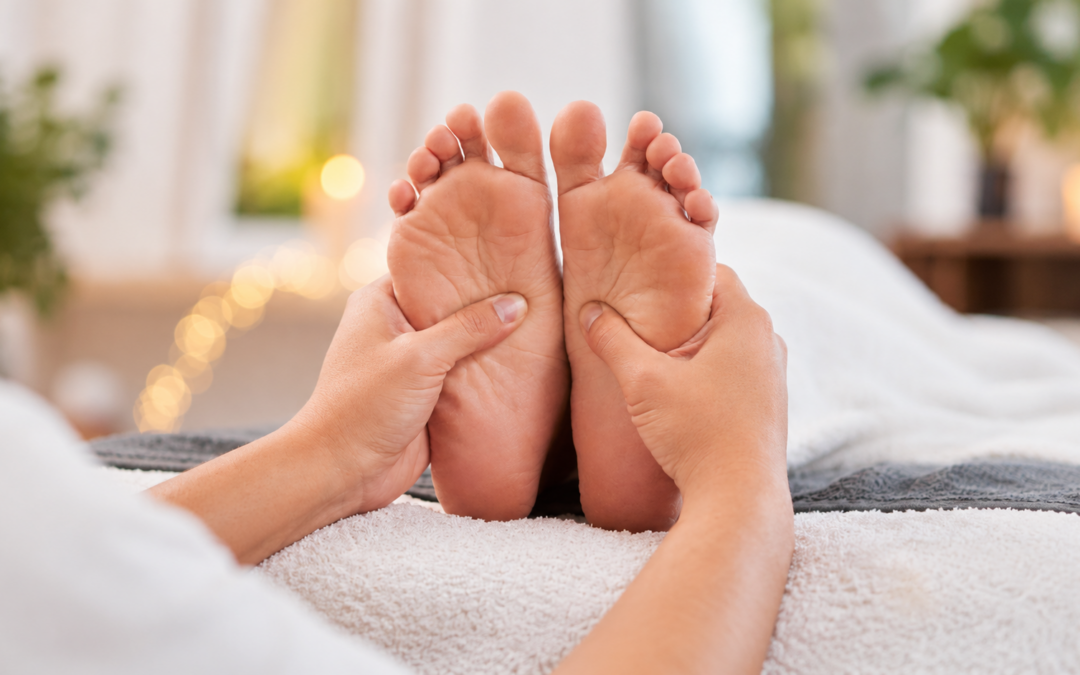
Few Words About Feet
Before we wrap them in socks and shoes and tuck them away for the winter, let’s consider our feet.
Our feet are one of the farthest things from our minds, literally, until they hurt. Yet, these hardworking appendages are our own personal scouts, constantly gathering information about the world beneath us.
Take a moment to think about the pleasures our bare feet deliver: texture, temperature, pressure, and movement. Imagine placing hot, tired feet onto a cool, wet bed of grass. Or the startling sensation of cold, flowing ocean waves washing over your feet after you’ve walked across hot, dry sand. Then imagine the coarse, warm texture of the sand beneath your feet as it gently thaws them after you’ve stayed in the chilly water just a little too long.
Our feet also alert us to danger in no uncertain terms. They have very little tolerance for sharp objects, such as rusty nails or shards of glass. Nor will they quietly tolerate footwear that is too loose, too tight, or simply uncomfortable for very long. They’re even particular about the surfaces we stand on. The feedback may not be as immediate as stepping on a piece of glass, but spending hours each day standing on hard cement floors can eventually take its toll. Our feet may rebel with persistent aches or chronic heel pain.
What other part of the body gives us such a direct experience of the world around us? What other part can our whole body, and our very sole, can feel so completely? Our feet are constantly communicating with us. Sometimes their messages are subtle; other times, they demand our immediate attention. Consider what powerful communicators our feet truly are as we explore the art and practice of foot reflexology.
a few feet
from our feet
the ocean bottom starts
~ Haiku by Gary Hotham
Credit: Chat GPT/ AI
Foot Reflexology: A Brief History
Foot reflexology is a complementary wellness practice based on the idea that specific areas of the feet correspond to other parts of the body. During a reflexology session, a practitioner applies pressure with thumbs and fingers to different areas of the foot. Techniques may include pressure, squeezing, kneading, massage, rotation, and gentle stretching.
Various forms of hand- and foot-pressure practices have been associated with cultures including Egypt, China, India, and Indigenous healing traditions. Although reflexology is often described as an ancient healing tradition, the form practiced today developed primarily during the twentieth century. The specific system known as “zone therapy” emerged in the United States in the early 1900s and is generally associated with American physician, Dr. William H. Fitzgerald. Fitzgerald proposed that the body could be divided into longitudinal zones. He beleived that applying pressure to one area might influence another within the same zone.
American physiotherapist Eunice Ingham later expanded these ideas, developing detailed maps of the feet and hands, and helping transform “zone therapy” into what became known as foot reflexology. Through her teaching and writing from the 1930s onward, Ingham played a major role in bringing the practice to a wider audience and shaping the form of reflexology familiar today.
Central Principles of Foot Reflexology
Reflexology is based on several central principles:
-
Correspondence: Specific areas of the feet are believed to correspond to particular organs, glands, and regions of the body.
- Zone theory: The body is conceptualized as being divided into longitudinal and transverse zones. Practitioners work within these zones, applying pressure to areas thought to correspond with other parts of the body.
- Pressure and relaxation: Focused pressure is intended to promote relaxation, ease tension, and support a sense of overall well-being.
-
Holistic care: Reflexology takes a broad view of well-being, considering physical comfort, stress, sleep, mood, and lifestyle as interconnected aspects of the person.
Reflexology charts commonly associate the toes with the head and neck, the ball of the foot with the chest and upper torso, the arch with the abdominal region, and the heel with the pelvis and lower body. These correspondences are part of reflexology theory and should not be confused with established anatomical pathways or proven physiological connections.
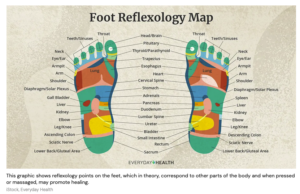
Credit: Everyday Health
Reflexology is sometimes described alongside other “microsystems”, such as auricular acupuncture and Korean hand and foot acupuncture. These approaches share the concept that a representation of the whole body can be mapped onto a smaller area of the body, such as the foot, hand, or ear. In this framework, stimulation of one location is thought to influence a corresponding area elsewhere in the body. Maps vary somewhat among different reflexology and microsystem traditions, so specific correspondences are not universal.
It is important to distinguish the traditional theory of reflexology from what has been established scientifically. The National Center for Complementary and Integrative Health (NCCIH) notes that the specific healing effects claimed for reflexology have not been proven. Some people may find reflexology relaxing or experience temporary relief of certain symptoms, but it should be viewed as a complementary practice rather than a substitute for appropriate medical evaluation or treatment. [1]
Plantar Fasciitis
Plantar fasciitis is one of the most common causes of heel pain. It involves irritation and degenerative changes in the plantar fascia, a strong band of connective tissue that runs along the bottom of the foot. Pain is often most noticeable with the first steps after waking or after sitting for an extended period. According to the American Academy of Orthopaedic Surgeons, excessive stress on the plantar fascia, unsupportive footwear, and tightness in the calf or plantar fascia may contribute to symptoms. [2] (Learn more in our Dec 2023 blog post, “Plantar Fasciitis: Stepping into Winter”.)
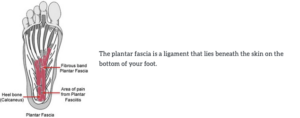
Credit: OrthoInfo
The center of the heel pad is traditionally associated with the sciatic nerve in reflexology charts. When working with this area, particularly in the presence of plantar fasciitis, gentle pressure may be more appropriate than deep, forceful work.
Reflexology theory suggests that working this area may influence both the local experience of heel discomfort and symptoms in the sciatic region. It can also serve as a reminder to consider whether factors elsewhere in the body may be contributing to the person’s foot pain.
Pain along the lower inner arch is associated in reflexology with the bladder and lower spine. Again, these are traditional correspondences rather than established diagnostic pathways.
When working with plantar fasciitis, a practitioner may work gently along the heel, arch, ankle, and related lower leg areas. The goal is not to “break up” the plantar fascia or alter its underlying structure. Deep, painful pressure directly over an irritated heel may aggravate symptoms. A gentler approach is more appropriate to promote comfort, relaxation, and ease.
Reflexology traditionally associates the right foot with the right side of the body and the left foot with the left side. However, when the affected foot is too painful to work on, a practitioner may choose to work on the unaffected foot through the correspondence system. This reflects a broader microsystem principle sometimes described as “like treats like”, in which stimulation of a corresponding area is used to address a concern elsewhere. Within this framework, there are rationales for working on both the same side and the opposite side of the body, depending on the practitioner’s approach and the client’s comfort.
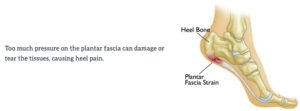
Credit: OrthoInfo
Morton Neuroma
Morton neuroma is a thickening and irritation of tissue surrounding a digital nerve, most often between the third and fourth toes. It can cause burning, sharp pain, tingling, or the sensation of standing on a pebble or a small stone with bare feet. Despite its name, it is not usually a true tumor. Compression from narrow shoes and pressure beneath the forefoot may contribute to its development. [3]
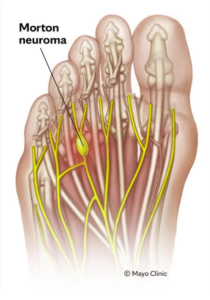
Credit: Mayo Clinic
Morton neuroma roughly falls within the eyes and ears zones on many reflexology charts. It is interesting to consider what this correspondence might suggest about factors beyond the immediate site of pain. The correspondence system also raises some worthwhile questions that may be worth exploring. If someone is experiencing visual or balance difficulties related to the eyes or ears, might they alter the way they walk? Perhaps they are spending more time on their toes or forefoot in an effort to feel the ground more securely?
The forefoot is richly equipped for sensory feedback and plays an important role in balance and fine adjustments during walking. It is not designed to carry excessive loads for prolonged periods. Increased weight-bearing through the forefoot could contribute to greater compression around the metatarsal heads and the sensitive digital nerves. This could be a mechanical factor for Morton neuroma.
Reflexology may be adapted by avoiding forceful pressure between the metatarsal heads or over the painful web space. Gentle work around the ankle, heel, and lower leg may be more comfortable. Persistent burning, numbness, or forefoot pain deserves assessment by a podiatrist or other qualified clinician.
When working with Morton neuroma, forceful pressure between the metatarsal heads or directly over the painful web space should be avoided. Gentle reflexology work around the ankle, heel, and lower leg may be more comfortable and allow the practitioner to work without aggravating the sensitive area.
A presenting problem in the foot can sometimes prompt questions about posture, gait, balance, sensory awareness, footwear, and other influences occurring farther from the site of discomfort. Persistent burning, numbness, tingling, or forefoot pain should be evaluated by a podiatrist or other qualified healthcare professional, particularly when symptoms persist or interfere with walking.
Bunions
A bunion is a bony prominence that develops at the base of the big toe, often accompanied by a gradual shift of the toe toward the smaller toes. The big toe is made up of two joints. The largest of the two is the metatarsophalangeal joint (MTP), where the first long bone of the foot (metatarsal) meets the first bone of the toe (phalanx). Bunions develop at the MTP joint.
Tight or narrow footwear can increase pressure and irritation around the joint. Wider shoes, protective padding, and professional guidance may help reduce discomfort, although conservative measures generally do not reverse the underlying structural deformity. [4]
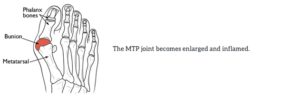
Credit: OrthoInfo
In reflexology, the area along the big-toe side of the foot is traditionally associated with the upper spine – from the region between the shoulder blades up through the neck and with the thymus and thyroid glands. Within the reflexology correspondence system, working this area is therefore thought to have a relationship with the upper back and neck.
While these correspondences are part of reflexology theory rather than established anatomical pathways, they can offer an interesting way to think about the body as an interconnected whole. Given how much tension we tend to carry through the neck and upper back, a little attention and TLC can only help!
When working with someone who has a bunion, reflexology should be adapted to avoid aggressive rubbing or pressure directly over the prominent joint, particularly if the area is tender, red, swollen, or inflamed. Gentle work around the rest of the foot, ankle, and lower leg can provide a more comfortable way to encourage relaxation without placing additional stress on the affected joint.
Peripheral Neuropathy
Peripheral neuropathy can cause burning, tingling, numbness, weakness, or reduced sensitivity in the feet. Diabetes can damage nerves as well as the small blood vessels that supply them, while some cancer treatments can also injure peripheral nerves. Chemotherapy-induced peripheral neuropathy may cause numbness, tingling, or “pins and needles” sensations that often begin in the hands and feet. [5] [6]
Neuropathy can affect the feet, hands, or both, and the location and intensity of symptoms can vary considerably from person to person. If you are curious about the reflexology perspective, you can refer to a reflexology chart to explore the traditional correspondences associated with the areas of the feet that are most affected.
Although some people with peripheral neuropathy may find gentle touch or manipulation relaxing and comforting, this is an area where extra caution is essential. Reduced sensation can make it difficult to recognize excessive pressure, heat, friction, skin injury, or an open sore. Before beginning a session, the practitioner should carefully inspect the skin and be alert for wounds, blisters, redness, or other signs of injury. Pressure should be light and controlled, heat should be avoided, and touch should stop if pain, unusual sensations, or any sign of tissue irritation develops.
When working directly on the feet is not advisable, there is another option within the reflexology tradition. American physiotherapist Eunice Ingham developed detailed correspondence maps for both the feet and hands. Her work helped establish and popularize modern foot and hand reflexology. A practitioner may therefore choose to work with the hands when the feet are particularly sensitive, painful, or otherwise unsuitable for direct manipulation.
Reflexology should not be used to diagnose or treat the underlying cause of peripheral neuropathy. Anyone experiencing new, worsening, or unexplained numbness, weakness, pain, or changes in the skin of the feet should seek appropriate medical evaluation.
Final Thoughts
Foot reflexology can be a calming and restorative addition to a broader wellness plan. Its greatest value may lie in relaxation, mindful touch, and developing a greater awareness of our feet and how they feel and function – not in diagnosing or curing medical conditions.
Our feet can offer us clues about how we move through the world, where we carry tension, and how our bodies respond to changes in posture, balance, and activity. The correspondence system can provide an intriguing framework for exploring these connections. Remember that these connections are part of reflexology theory, rather than established anatomical pathways.
When pain, numbness, swelling, deformity, or changes in the skin persist, professional medical evaluation should take priority. Reflexology can complement appropriate medical care, but it should never take its place.
Next month, we will turn our attention from the feet to the ears and explore the benefits and practice of auricular acupuncture.
This blog is not intended to replace a consultation with a medical professional. Please seek attention from a clinician for any of the conditions mentioned above. If symptoms are severe, persistent, or life-threatening, seek medical intervention as soon as possible. Acupuncture and massage therapy may be important supports for allopathic interventions.
Sources
1. https://www.nccih.nih.gov/health/reflexology
2. https://www.orthoinfo.org/diseases–conditions/plantar-fasciitis-and-bone-spurs
3. https://www.orthoinfo.org/diseases–conditions/mortons-neuroma
4. https://www.orthoinfo.org/diseases–conditions/bunions/
6. https://www.cancer.gov/about-cancer/treatment/side-effects/nerve-problems
https://massagecraft.com/plantar-fasciitis-stepping-in-to-winter/
https://www.everydayhealth.com/integrative-health/potential-health-benefits-of-reflexology/
https://www.sciencedirect.com/science/article/pii/S1744388122000743
https://www.amtamassage.org/resources/exploring-massage-techniques/what-is-reflexology/
https://www.mayoclinic.org/diseases-conditions/mortons-neuroma/symptoms-causes/syc-20351935
https://my.clevelandclinic.org/health/diseases/14386-bunions-hallux-valgus
https://www.mayoclinic.org/diseases-conditions/peripheral-neuropathy/symptoms-causes/syc-20352061
https://www.sciencedirect.com/science/article/abs/pii/S1876382019304421 (Korean Hand Acupuncture)