
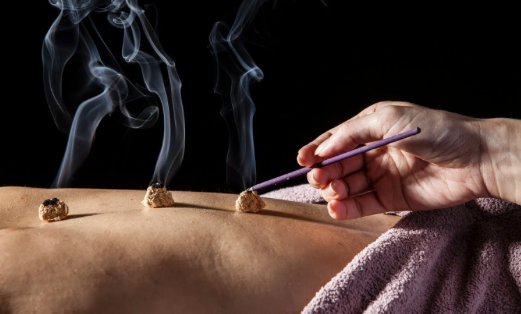
Did you know that the application of heat has been wed with the practice of acupuncture practically since time immemorial? This is especially true in the cooler climes of Northern China. Moxibustion has been used to prevent and cure diseases for more than 2500 years. Zuo zhuan of the pre-Qin dynasty in China, which recorded a disease discussion occurred in 581 B.C., is considered to be the earliest literature of moxibustion. The pinyin word for acupuncture is “zhenjiu”, which translates to “acumoxa”.
In this blog, we will define moxibustion and introduce you to its various applications in both Chinese and Japanese traditions of acupuncture.
Moxibustion
What is “moxibustion”? It is a time-honored therapeutic technique rooted in traditional East Asian medicine. It is a form of heat therapy in which a traditional, dried herb is burned on or very near the surface of the skin to stimulate acupuncture points. Moxibustion is often integrated into acupuncture treatments, with or without needles. In conversation, the shortened version of the word, “moxa”, refers both to the herb used, as well as this method of heat therapy.
Moxa, mugwort, or “mo kusa” in Japanese
Moxa, the herb Artemesia vulgaris, is commonly known as mugwort or wormwood. It is a prolific herb that grows in wastelands, marshlands, and open fields. It is native to temperate climates in Europe, Asia, North Africa, and Alaska. It has become naturalized in North America and grows to about 4 feet high by the end of summer in Maine. It has beautiful, velvety, serrated dark green leaves with a silver underside and silvery yellow or reddish flower heads. Crunch its leaves between your fingers and inhale the pungent, chrysanthemum scent.
Historically, A. vulgaris has been referred to as the “mother of herbs” since the Middle Ages. It has a historical reputation as a women’s health remedy, supporting female reproductive disorders and regulating menstrual cycles. It is associated with the Greek goddess of childbirth, Artemis. The name mugwort is thought to have come from England, when it was used as a flavoring in beer before the introduction of hops. First, dried mugwort flowers were added to malt liquor, and then this was added to beer.
In both Vietnam and Germany, mugwort is used in cooking as an aromatic herb. In China, the crunchy stalks of young shoots are a seasonal vegetable often used in stir fries. The dried leaves can also be smoked or used to make a tea, to promote lucid dreaming and ancestral communication. In Nepal, the plant is used as an offering, for cleansing and protecting one’s home, as incense, and also as medicine.
Mugwort is widely used in traditional Chinese, European, and Hindu medicines for many reasons. First, it grows plentifully, so it’s not costly. Second, few people have allergic reactions to it. Third, it contains a range of phytochemicals associated with anti-inflammatory properties. Fourth, it burns slowly and evenly, almost as an ember. Although a burn is always a risk of treatment, it is quite safe and predictable to use. Medicinally, the thermal properties of mugwort “dry damp”, warm blood, and move stagnation. In Chinese Medicine, pain and inflammatory conditions are often thought to take up residence under damp, cold, and stagnant conditions. This makes moxa an ideal accompaniment to acupuncture needles.

Moxibustion Therapies
The following are various methods of applying moxibustion and their unique indications. We will start with indirect forms, where the moxa does not come in direct contact with the skin. Then we will address direct forms, where the moxa is placed directly on the skin. Moxa’s unique properties alongside gentle heat help stimulate circulation, strengthen the immune system, and support the flow of Qi, vital energy.
Indirect Moxibustion
Warming needle moxa or “kyotoshin” in Japanese
Needles are inserted into points along the meridians or painful points, near or far from the issue. Loose, dried mugwort is rolled into a ball and placed on the needle handle. Then the ball is lit. The warming sensation will slowly increase, peak, and then begin to abate as the moxa ball burns out. The client may feel heat as a radiant warmth on the skin surface as well as a deeper penetration. If a heat sensation is not felt by the client on the first application then it may be repeated until it is.
Warming needle moxa is used to treat arthritic conditions, such as in the knee, shoulder, or back. It is also used to treat internal imbalances such as constipation, diarrhea, and menstrual cramps.

Moxa pole
There are two kinds of moxa poles and both look like large cigars. One type of moxa pole is made from dried mugwort wrapped in paper. One end of the pole is lit and then it is held or passed over an acupuncture point or needle. The acupuncturist monitors changes in skin color. Evidence of the desired change in blood flow is a light pink halo appearing around the point. Once this occurs, the acupuncturist removes the heat. As a precaution, it is suggested to have a few fingers around the point or needle in order to monitor the amount of heat transferred. The client is likely to report feeling heat, as well.
This form of moxa pole is used less, due to its pungent scent, copious ashes, and smokiness. More clinics use the second kind – a smokeless moxa pole. This consists of dried, compressed mugwort that is excellent for heat transference, but emits little odor or smoke. It is not wrapped in paper, so it can be safely held to the needle until the client reports feeling warmth. The beauty of the moxa pole is that clients can be instructed on its use at home for various ailments and painful conditions.
Indirect moxibustion via the moxa pole is excellent for warming the needle. It is also excellent for hovering above troubled areas, such as the hands and the feet, due to neuropathy. Hovering the pole over the top of the head can help quiet the mind and relieve headaches. Moxa pole over the Dan Tien, an area just below the belly button, can increase energy, and soothe diarrhea or menstrual cramps. Another well known indication is to turn a breech birth. The moxa pole is hovered over the last point of the Bladder meridian on the outside edge of the pinky toe. This is typically done between week 34-37 for breech presentation, and only under an acupuncturist’s direction.

Salt moxa in the navel
Another indirect form of moxibustion is salt moxa in the navel. A piece of gauze is placed in the bellybutton and then the area is filled with coarse salt. Multiple mugwort cones are lit on the salt surface in succession. The cone is allowed to burn down to two-thirds. It is then removed and extinguished in a bowl of water. This method is done for extremely depleted or fatigued individuals and those with chronic watery diarrhea and cold lower abdomens. The more depleted the person is, the more cones it takes before the client feels heat. Sometimes, this is the only technique done in a treatment because it can take so long to feel a shift in weak individuals. For these clients, it is important to build their Qi with heat before manipulation with needles.

Direct Moxibustion
Thread moxa or “okyu” in Japanese
There is always a risk of burn when treating with moxibustion. The difference with thread moxa is that the mild burn that is felt is the therapeutic medium. Thread moxa is much more popular in Japan than China. In fact, there are practitioners who exclusively use “okyu” in Japan in accordance with the principles of Traditional Chinese Medicine. Like the moxa pole, thread moxa can be performed at home by the client or educated carers. This is an excellent way to enhance and prolong the benefits of acupuncture treatment.
Thread moxa is applied directly on the skin. Measures are taken to protect the skin by first applying Shiunko cream to the points that will be treated. Shiunko cream is a sesame oil and beeswax base infused with blood-moving herbs. It has numerous functions: it is red so it clearly marks the point to be treated; it is gooey so it gives the thread moxa something to stick to; it contains dongquai, an herb that treats blood stagnation in painful conditions; it also protects the skin from a burn.
Thread moxa is applied numerous times to the same point. Mugwort is rolled in to a very thin, delicate thread. It is placed perpendicular to the point on the Shiunko cream. It is lit from the top with an incense stick and allowed to burn down to the skin. The acupuncturist snuffs out the thread just as it transfers a bit of a heat ‘bite’. Ash from previous moxa threads are allowed to build up on the treatment point because it serves as an additional, protective barrier for the skin. The process is repeated to the client’s tolerance. Some find this revitalizing, fleeting ‘bite’ to be quite pleasant and relaxing.
Thread moxa is credited with increasing immunity. Research shows that there is a change in blood chemistry at the site of the application. There is an increase in red blood cell and white blood cell production as well as a histamine response to the heat ‘bite’. Thread moxa also softens hard, painful points that remain after an acupuncture treatment. It is credited with an immediate reduction in pain and inflammation that is sustained with repeated applications.
Thread moxa has a penetrating effect and can be used where needling is contraindicated or not tolerated by the client. There are numerous ‘special points’ used to treat particular internal conditions. Heat enters the acupuncture point and the meridian and can have effects near and far. Japanese acupuncturist Sorei Yanagiya conducted an experiment applying moxibustion on a watermelon, which has an even greater concentration of water than the human body. After applying numerous moxa threads to the skin of the watermelon, there was no evidence of a burn on the surface. However, when Yanagiya sliced the watermelon, he observed a thin yellow line through the rind of the melon where thread moxa was applied. He experimented with applying other materials, such as cotton and wheat straw to the same area, with no evidence of penetration through the rind.
As with the moxa pole, clients or carers can be instructed on home use of thread moxa. While it requires a little more patience and practice than using the moxa pole, it is a very productive, cost-effective way to continue the benefits of acupuncture at home.

Cone moxa or “chinetskyu” in Japanese
Cone moxa is also applied directly to the skin. Loose, dried mugwort is shaped into Hershey Kiss-sized pieces or smaller. The acupuncturist prepares a number of cones before starting the treatment and has a bowlful of water at the ready for extinguishing the cones. The cones are very similar to the ones applied during salt moxa in the navel. In contrast to thread moxa, the cone is larger and is not allowed to burn completely down to the skin.
Water or Shiunko cream is first applied to the skin. A moxa cone is applied to the desired points(s) and lit. It is allowed to burn down about three-quarters, or until smoke starts to curl up from underneath the base. The cone is then removed and doused in water. As with thread moxa, the process is repeated until the client experiences a very gentle, mild heat in the area.
This application is excellent for dispersing the blood stagnation evident in bruising. It is also potent for sensory pain associated with Shingles.

Conclusion
In the West, we often associate acupuncture with needles exclusively. Traditional Chinese Medicine (TCM) encompasses the indirect and direct application of heat with needling. There are many other influential branches of TCM: Herbs and Nutrition, Massage, as well as Exercise and Meditation in the form of Qi Gong, Tai Chi, and Martial Arts.
In this blog, we aimed to expand your understanding of the breadth and depth of acupuncture and how moxibustion can be incorporated with or without needles.
This blog is not intended to replace consultation with your medical professional. Please seek medical attention from a clinician for any of the conditions mentioned above. Acupuncture and moxibustion may be important supports for allopathic intervention.
Sources
Manaka, Y., Itaya, K., & Birch, S. (1995). Chasing the Dragon’s Tail. Brookline, MA: Paradigm Publications.
Mizutani, J. (2012). Practical Moxibustion Therapy (Foreword by S. Brown). Vancouver, BC: North American Journal of Oriental Medicine.
https://acaacupuncture.com/exploring-moxibustion-in-acupuncture-benefits-uses-and-what-to-expect
https://www.capitalchinesemedicine.com.au/what-is-moxibustion
https://www.oasisofharmonywellness.com/blog/moxa-therapy-in-chinese-medicine