

Auricular therapy, often called ear acupuncture, uses needles, tiny press needles, seeds, or gentle pressure to stimulate selected points on the outer ear. Its appeal is practical; a small area of the body becomes a focus for care aimed at pain, stress, or other symptoms. The modern system of auricular therapy is associated with French physician, Dr. Paul Nogier. His son, Dr. Raphaël Nogier, later contributed historical research and documentation.
As a follow-up to our September blog, (https://massagecraft.com/foot-reflexology), we will delve into this promising correspondence system. We will look at a brief history of ear acupuncture including a few words about two other widely used auricular acupuncture protocols, the National Acupuncture Detox Association protocol, (NADA), and Battlefield Acupuncture. We will hypothesize on the mechanism of action. We will close with guidelines on how to find a qualified practitioner of this valuable microsystems tool. Finally, we will also advise when it is important to seek medical attention for your condition.
A Brief History and Evolution
The ear has been used in various healing traditions in attempts to relieve pain for centeries. But the detailed body map associated with modern auriculotherapy is a relatively recent development, not an ancient chart. Some research has concluded that this complementary approach shows promise in addressing pain, mild psychiatric disorders, addictions, and some functional disorders such as fatigue, insomnia, and autonomic dysregulation.
Scientific research on complementary therapies, like auricular acupuncture, has increased and improved over the past 75 years. Research conclusions cited in this blog reflect the limitations if current research methods. The inherent variables of complementary therapies don’t often conform to the gold standard of double-blind, random, controlled trials. The research in this blog has concluded that there is some efficacy regarding the practice of auricular therapies that warrant further research. In the meantime, the validity of ear acupuncture is driven by practitioners and clients alike, evidenced by its expanding and evolving use as truly complementary therapy.
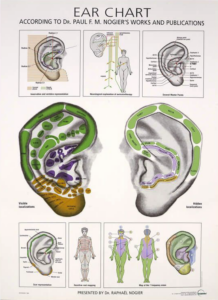
In 1951, French physician Paul Nogier learned from his Lyon patients about a Marseille healer who cauterized a specific ear point to relieve sciatica. Intrigued by this account, Nogier began a thorough investigation. He systematically explored ear points and their possible relationships to symptoms in different parts of the body. The specificity of the Nogier protocol relies on testing and treating only the most reactive points. This allows both the client and practitioner to better explore the root causes of a disorder perhaps never considered, based on the corresponding areas of reactivity.
Through his observations, Dr. Nogier developed the concept of a somatotopic map of the ear. He proposed that the body could be represented on the auricle in the form of an inverted fetus. In this model, the head corresponds to the earlobe, the spine follows the inner ridge of the ear, and other body regions are mapped across the auricle. Nogier published an early version of this ear map in the mid 1950s and continued refining his system over subsequent decades.
His work helped shape the development and international spread of auricular acupuncture, influencing later approaches, including Chinese auricular acupuncture charts. His son, Dr. Raphaël Nogier, subsequently contributed historical research and documentation that helped clarify and preserve this European lineage. His role is best understood as that of a later historian and contributor, rather than a co-originator of his father’s original mapping system. [1]
Credit: Lhasa Oms
What Conditions Might Auricular Therapy Help Address?
The most well-supported use of auricular therapy is as a complementary approach to symptom management, particularly pain relief. The U.S. National Center for Complementary and Integrative Health (NCCIH) has summarized research showing promising results for chronic back pain and cancer-related pain. Reviews have reported reductions in pain intensity, with one finding greater pain relief from auricular acupuncture than from a sham treatment. [2]
Auricular acupuncture and other forms of ear stimulation have been investigated as complementary approaches for anxiety, sleep disturbances, nausea, pain, and substance-use disorders. However, the evidence varies by condition, and findings remain mixed. Studies differ in their techniques, protocols, and overall quality. These variations make it difficult to draw firm conclusions about its effectiveness across conditions. Study results do not establish auricular therapy as a stand-alone treatment or show that it works equally well for everyone. Its potential role is best understood as complementary symptom management rather than a means of diagnosis or cure, or a substitute for established medical care.
The NADA Protocol
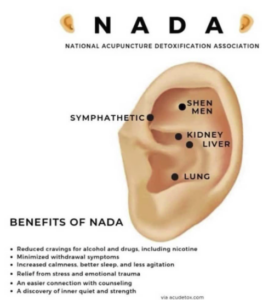
Dr. Michael O. Smith, a psychiatrist specializing in addiction treatment, helped pioneer the National Acupuncture Detoxification Association (NADA) ear acupuncture protocol. He also introduced a standardized five-point ear acupuncture protocol as one component of a broader, comprehensive approach to addiction recovery.
Dr. Smith served as director of the Lincoln Hospital Recovery Center in the Bronx, New York for more than 30 years. This allowed him to observe and collect data on the potential benefits of incorporating auricular acupuncture into long-term recovery services. Smith reported encouraging outcomes, including reduced relapse rates during the six months following treatment.
Today, the NADA protocol is used in a variety of settings, including addiction recovery, behavioral health, and trauma-informed care. Regulations governing who may administer the protocol vary by state. In some jurisdictions, appropriately trained non-acupuncturists may provide it within the scope of their permitted practice. The NADA protocol is intended to complement other services, rather than replace addiction treatment or mental health care. [3]
Credit: NADA
Battlefield Acupuncture
Richard C. Niemtzow, MD, PhD, MPH, was a retired Air Force colonel and the first full-time physician acupuncturist in the Armed Forces. He developed Battlefield Acupuncture (BFA) in 2001 as a rapid, drug-free method to help combat pain and reduce opioid dependence in military personnel.
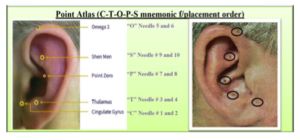
BFA is a standardized, five-point auricular acupuncture technique designed to provide rapid pain relief. It is relatively inexpensive and easier to learn. The BFA protocol has spread widely across military hospitals, the Pentagon, and Department of Veterans Affairs (VA) healthcare facilities. [7]
During a BFA treatment, a clinician inserts up to five sterile, semi-permanent auricular needles (Aiguille Semi-Permanente® [ASP®]) into specific points on one or both ears. BFA is a type of auricular (ear) acupuncture that is based on the “meridian system” from traditional Chinese acupuncture and the correspondence system from reflexology, in which specific regions of the external ear are understood to correspond to different parts and functions of the body. [6] [8]
Clinical evidence regarding BFA is mixed and scientific research studies are ongoing. Brain-imaging studies of auricular acupuncture have reported changes in activity within regions involved in pain perception and modulation. Some studies report short-term reductions in pain. Others have found no significant improvement compared with control or alternative treatment conditions.
Accordingly, BFA may be considered a complementary, nonpharmacologic option for selected patients. Current evidence does not establish it as a consistently effective treatment for chronic pain or as a substitute for established pain-management strategies. Its potential to reduce long-term opioid use also remains uncertain. BFA should therefore be integrated into individualized, evidence-based care, with treatment decisions guided by patient needs, clinical response, and safety considerations. [2]
Credit: AIM at Joint Base
How Might Auricular Stimulation Work?
The external ear receives sensory input from several nerves, including the auricular branch of the vagus nerve, branches of the trigeminal nerve, and nerves arising from the upper cervical spinal nerves. One proposed mechanism is that stimulation of particular auricular regions, especially those innervated by the auricular branch of the vagus nerve, transmits sensory signals to brainstem pathways involved in autonomic regulation and pain processing. These pathways may, in turn, influence central nervous system activity associated with pain perception and physiological responses.
This neuroanatomical framework offers a plausible explanation for how auricular stimulation may influence sensations or body-state responses without requiring the ear to contain a literal miniature version of every organ. The auricular pathway is a research hypothesis, not a complete explanation. Nevertheless, the precise mechanisms of action, the degree of anatomical and functional specificity of individual ear points, and the relative contributions of stimulation, expectancy, and other contextual factors remain incompletely understood. These proposed pathways should therefore be regarded as plausible mechanisms under investigation, rather than established explanations of clinical benefit.
How Auriculotherapy Compares with Other Correspondence Therapies
Auriculotherapy, foot reflexology, and Korean hand acupuncture are often described as “microsystem” approaches. Each proposes that a localized area of the body can be used to influence or represent the body as a whole. However, their maps and underlying theories differ, and these correspondences should not be interpreted as established anatomical representations.
Foot reflexology involves applying pressure to specific areas of the feet, and, in some practices, the hands. These areas are traditionally believed to correspond to particular organs, body regions, or physiological functions. The technique is generally noninvasive and is commonly used to promote relaxation and comfort. [4]
Korean hand therapy, also known as Koryo hand acupuncture, was developed by Yoo Tae Wooin 1971. This approach maps body regions and meridian-like pathways onto the hands and uses techniques such as acupuncture needles or other forms of stimulation. Published descriptions of the system identify 345 corresponding hand points and a network of hand-based meridians intended to reflect the body’s organization. [5] These correspondences represent the system’s theoretical framework, rather than universally accepted anatomical relationships.
Auriculotherapy shares several features with Korean hand acupuncture, particularly the use of mapped points, and in some applications, acupuncture-style stimulation. Foot reflexology differs primarily in its reliance on manual pressure rather than needle-based stimulation. Although all three approaches are based on correspondence, the concept that localized stimulation may influence symptoms elsewhere in the body, their proposed mechanisms and clinical evidence must be evaluated separately.
Evidence supporting one modality cannot automatically be extrapolated to another. For example, findings from studies of conventional acupuncture do not, by themselves, validate the specific point maps or therapeutic claims of auriculotherapy or Korean hand acupuncture. Similarly, an observed benefit, such as relaxation or short-term symptom relief, does not establish the accuracy of proposed organ correspondences.
Overall, these modalities may have a role as complementary approaches to symptom management, but their effectiveness depends on the condition being treated and the quality of the available evidence. Auriculotherapy has shown potential for certain pain-related applications, although findings remain mixed and further rigorous research is needed to establish its clinical benefits.
A Safe, Realistic Approach
Choose a qualified practitioner who uses sterile, single-use needles and clearly explains the potential benefits, limitations, and risks of auricular therapy. For those who prefer non-needle approaches, ear seeds or acupressure may offer alternatives. Persistent pain, new neurological symptoms, or signs of serious illness warrant appropriate medical assessment. When used thoughtfully, auricular therapy may serve as a complementary tool within a broader care plan, but it should never replace evidence-based diagnosis or treatment.
This blog is not intended to replace a consultation with a medical professional. Please seek attention from a clinician for any of the conditions mentioned above. If symptoms are severe, persistent, or life-threatening, seek medical intervention as soon as possible. Acupuncture and massage therapy may be important supports for allopathic interventions.
Sources
[1] https://pmc.ncbi.nlm.nih.gov/articles/PMC8716479/
[2] https://www.nccih.nih.gov/health/acupuncture-effectiveness-and-safety
[3] https://acupuncturemasterclass.com/nada-protocol/
[4] https://massagecraft.com/foot-reflexology
[5] https://www.e-hpr.org/journal/view.php?number=474
[6] Battlefield Acupuncture Handbook. 2021, U.S. Air Force Acupuncture and Integrative Medical (AIM) Center located at Joint Base Andrews, Prince George’s County, MD. https://jts.health.mil/assets/docs/education/Battlefield_Acupuncture_Handbook.pdf
[7] https://pmc.ncbi.nlm.nih.gov/articles/PMC6011364/
[8] https://www.research.va.gov/currents/0821-Battlefield-acupuncture.cfm
https://pubmed.ncbi.nlm.nih.gov/25514687/
https://www.veteranshealthlibrary.va.gov/RelatedItems/142,41548_VA
https://academic.oup.com/painmedicine/article-abstract/22/8/1721/6189013/
https://pmc.ncbi.nlm.nih.gov/articles/PMC7044765/
https://www.insightacupuncture.ca/post/what-is-ear-reflexology-and-what-are-the-potential-benefits